

64% would trust AI with their money, 18% already do - Story 4 of 5
Consumers did not wait for the profession to be ready. Story 4 of 5 from The Australian Financial Adviser Market 2026.
Roughly 3.6 million Australian entities have a genuine need for advice against a workforce of 15,012, and something is already moving into that space.
ASIC's own Moneysmart research, run by YouGov in late 2025, found 18% of Gen Z use AI platforms for financial guidance while 64% say they would trust AI for money advice, including one in six who completely trust it. Stated trust is running well ahead of actual use, and that gap is the whole story. Adoption is not confined to the young either. Compare Club's AI Index found 16.6% of Australians have already used AI for a financial decision with a further 30.9% intending to, while a 2025 RACQ Bank survey found 45% of young Queenslanders had followed AI financial advice without consulting an expert.

Gen Z use and trust of AI for financial guidance. The Australian Financial Adviser Market 2026, Padua Solutions.
The Australian Financial Adviser Market 2026 is Padua's data-driven read on the state of the profession. Drawing on the ASIC Financial Adviser Register and adviser exam data, it maps six forces behind a market that has stopped shrinking but is far from recovered: 15,012 advisers, ageing fast, against 3.6 million Australians who need advice. The conclusion is a shift in the question itself, from how to grow the workforce to how to get more from the one we have.
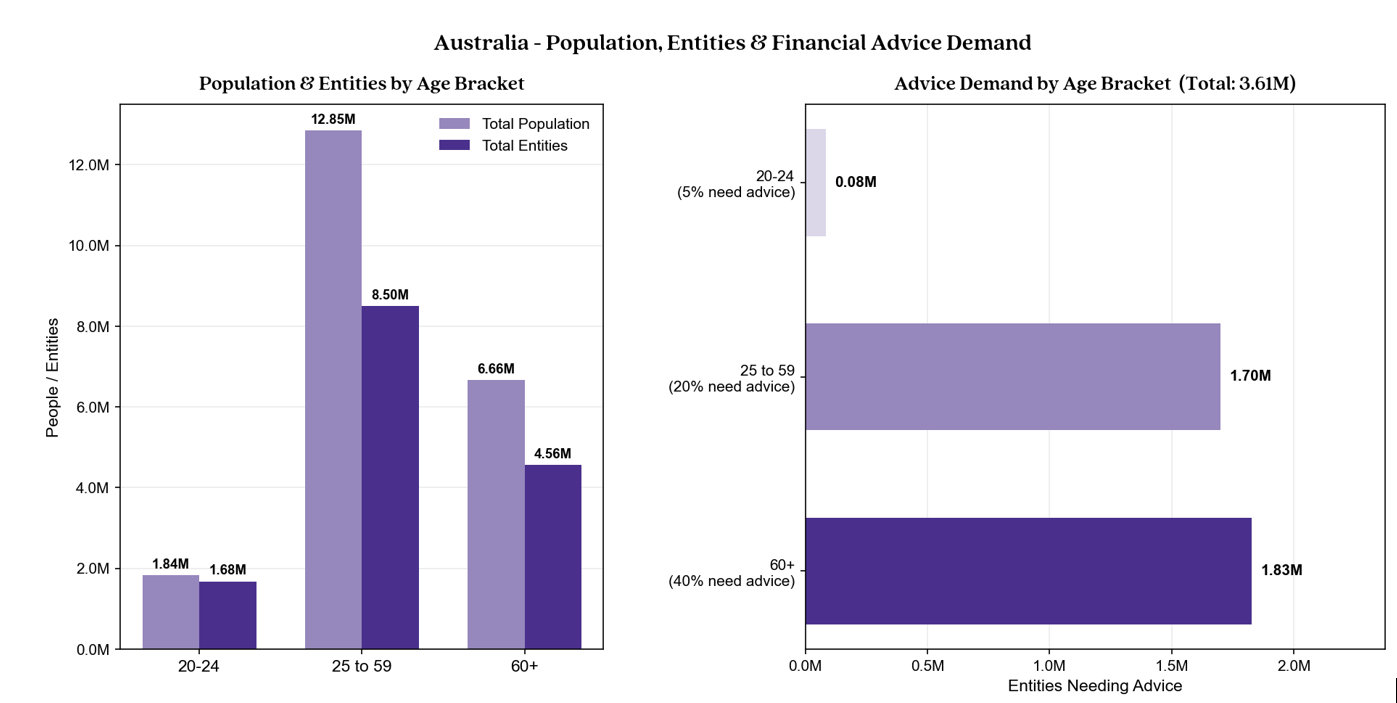
Entities represent adults and couples from ABS census data, with a couple counted once as a single advice relationship. Population is drawn from the ABS 2021 Census adjusted for growth to 2026. Advice need percentages are internal Padua estimates, indicative of scale rather than precisely measured demand.
The license, not the technology
In June 2026 the first licensed AI advice app aimed directly at consumers reached the Australian market. The significant feature is not the AI. General purpose tools such as ChatGPT, Claude and Gemini are not licensed to provide personal advice under the Corporations Act. A licensed platform sits inside the same regulatory perimeter as a traditional practice, carrying a best interests duty, advice documentation and supervision by qualified human advisers. That distinction is the entire proposition, and it is the one worth watching.
Offshore the direction is clearer again. On 15 May 2026 OpenAI launched a personal finance capability inside ChatGPT, letting users connect their real bank, credit card and brokerage accounts and ask questions grounded in their own data. Within six weeks it had spread from the premium tier to the far larger Plus base across the United States. Read only, positioned as general guidance, stopping just short of the licensed advice line. The world's most widely used AI assistant is now answering money questions from people's actual financial data at close to zero cost.
The governance gap lands at the small end
ASIC set out its position in REP 798, Beware the Gap. Reviewing 624 AI use cases across 23 financial services and credit licensees, it found 57% were less than two years old or still in development, and 61% of licensees planned to increase their AI use within twelve months. Generative AI is rising fastest, at 5% of use cases in production but 22% of those in development. Yet only 12 of the 23 licensees had AI policies referencing fairness, and only 10 referenced disclosing AI use to affected consumers.
The framework is technology neutral. Existing licensee obligations, directors' duties and consumer protection provisions apply whether AI is used or not. Which means the risks the regulator flags, bias, false information and black box reasoning, fall hardest on the smaller licenses that now make up most of the market. Story 3 put 88% of the register at nine advisers or fewer, holding much of the profession's deepest experience and the least compliance infrastructure.
All three forces pull the same way. More advice, delivered more cheaply, to more Australians. Whether that expansion is safe depends on whether the licensing, the documentation, the human oversight and the audit trail keep pace with the technology.
That is not a reason to sit it out. It is the reason to build the foundations first. Padua pairs AI supported advice documentation with Australian trained paraplanners and dual layer QA, so the audit trail is built in rather than retrofitted after the fact.
Building institutional-grade compliance in-house is not realistic at this scale. The alternative is to access it from outside, which is exactly what Padua's dual-layer QA, Australian-trained paraplanners and audit-ready documentation are built for.
Next in the series. Story 5, the 6,220 who passed and never practiced.
Read the full report, The Australian Financial Adviser Market 2026
Explore the data behind the report at wealthdata.com.au, including the free Adviser Movement Dashboards.
If you have any questions about the content of the report contact Lavon.Koopelian@paduasolutions.com

First Month Now Only $39.00 Selecting 'YEARLY' cost is only $950