

The 6,220 Who Passed and Don’t Practice - Story 5 of 5
The last story in the series. More people have cleared the adviser exam than have ever practiced, and the gap has almost tripled in four years. Story 5 of 5 from The Australian Financial Adviser Market 2026.
Every entrant must clear the financial adviser exam. It was the hardest gate the profession has ever set, and for years it was blamed for the shortage of new advisers. The data says the gate is not the problem.
By June 2026 some 21,113 people had passed the exam while only 14,893 were practicing as of July 2026. That is a gap of 6,220, almost triple the 2,228 recorded four years earlier. A pass never expires, so this is not a backlog working its way through. It is a standing reservoir of exam-qualified people who are not advising, and arguably the profession's most accessible source of latent supply. A group of these 6000 are Advisers who have passed the Exam and have since ceased as an Adviser but this does not account for any meaning
The Numbers at a Glance
6,220 exam-qualified people now sit outside the register, up from 2,228 four years ago
(-1,435) the cumulative net change in active advisers since November 2022, despite 120 to 225 new passers every sitting
72% the most recent pass rate, with the average running at about 70% since the March 2024 reforms
The Australian Financial Adviser Market 2026 is Padua's data-driven read on the state of the profession. Drawing on the ASIC Financial Adviser Register and adviser exam data, it maps six forces behind a market that has stopped shrinking but is far from recovered: 15,012 advisers, ageing fast, against 3.6 million Australians who need advice. The conclusion is a shift in the question itself, from how to grow the workforce to how to get more from the one we have.
The Gate Has Already Opened
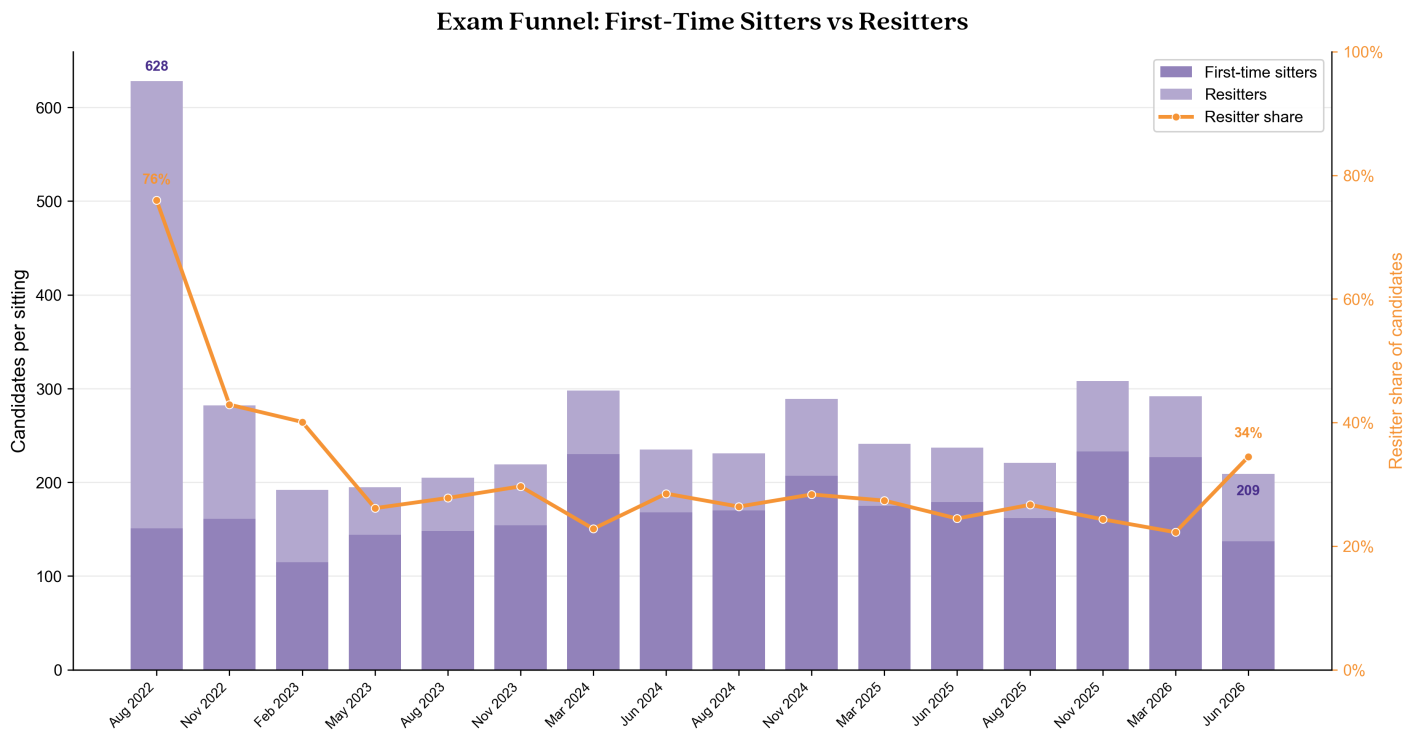
Candidates per sitting split by first-time sitters and resitters. The Australian Financial Adviser Market 2026, Padua Solutions.
The August 2022 sitting closed the deadline era, drawing 628 candidates and returning the lowest pass rate on record at 52% as existing advisers made their final permitted attempts. Resitters made up 76% of that queue, a backlog of established advisers paying $1,500 a go.
The exam that runs today is a different thing. Sittings have settled at roughly 190 to 310 candidates, the most recent pass rate was 72%, and the March 2024 changes to an all multiple-choice format, along with letting candidates sit while still studying, have lifted the average to about 70%. Resitters are now between 22% and 34% of the queue, leaving a funnel dominated by first-time sitters. That is the healthier shape for a profession rebuilding its pipeline.
Throughput Without Growth
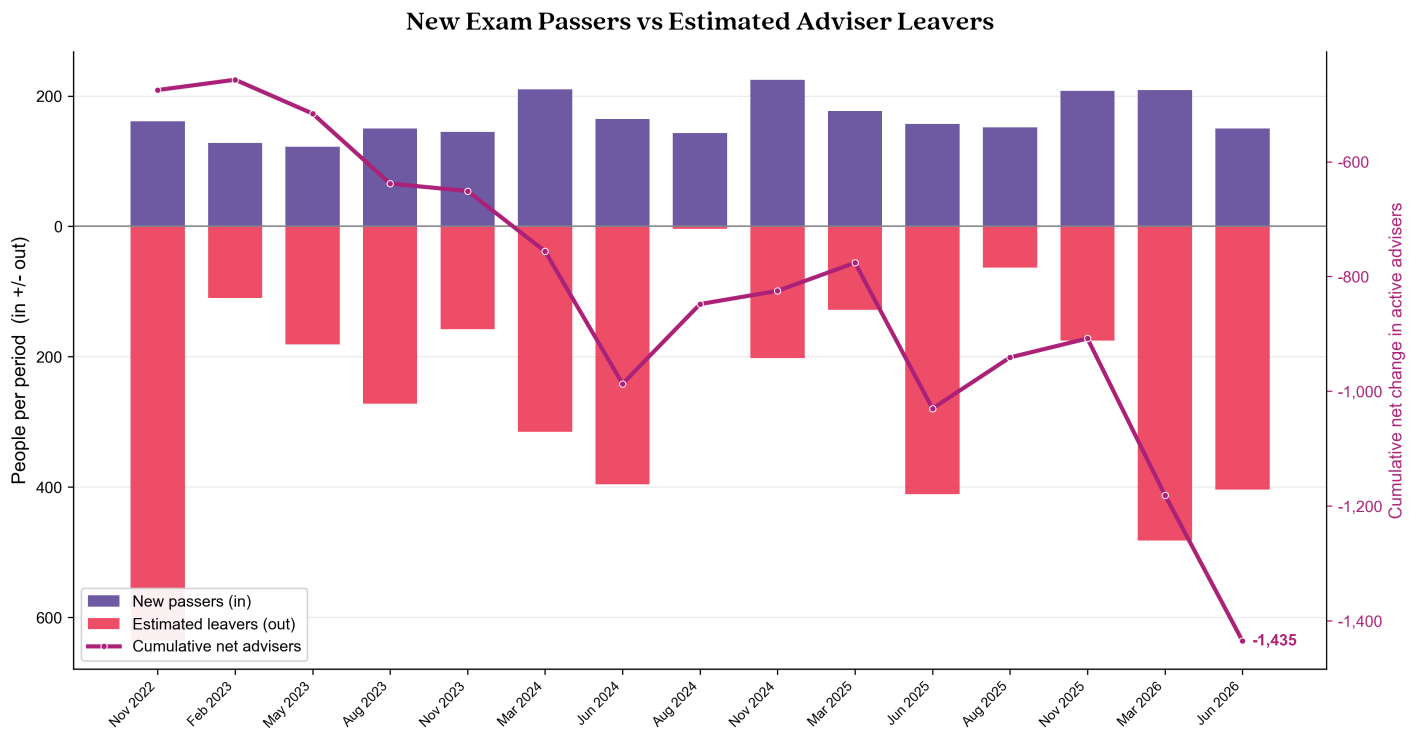
New passers against estimated leavers, with the cumulative net change in active advisers. The Australian Financial Adviser Market 2026, Padua Solutions.
None of that throughput has turned into growth. Outflows have exceeded inflows in most periods since November 2022, and the cumulative net position has fallen by (-1,435) active advisers across that stretch even as 120 to 225 people passed at every sitting. The constraint was never the supply of people able to pass. It is the conversion of passers into practising advisers, and then keeping them.
The retention data explains where they go. For advisers who commenced after 2000, the median career length of those who departed is just four years, rising only to six for the period from 2019. The survival curve flattens sharply after year six, so the profession can hold committed practitioners. It is the first six years that filter too many out before they get there.
A Reservoir, Not a Solution
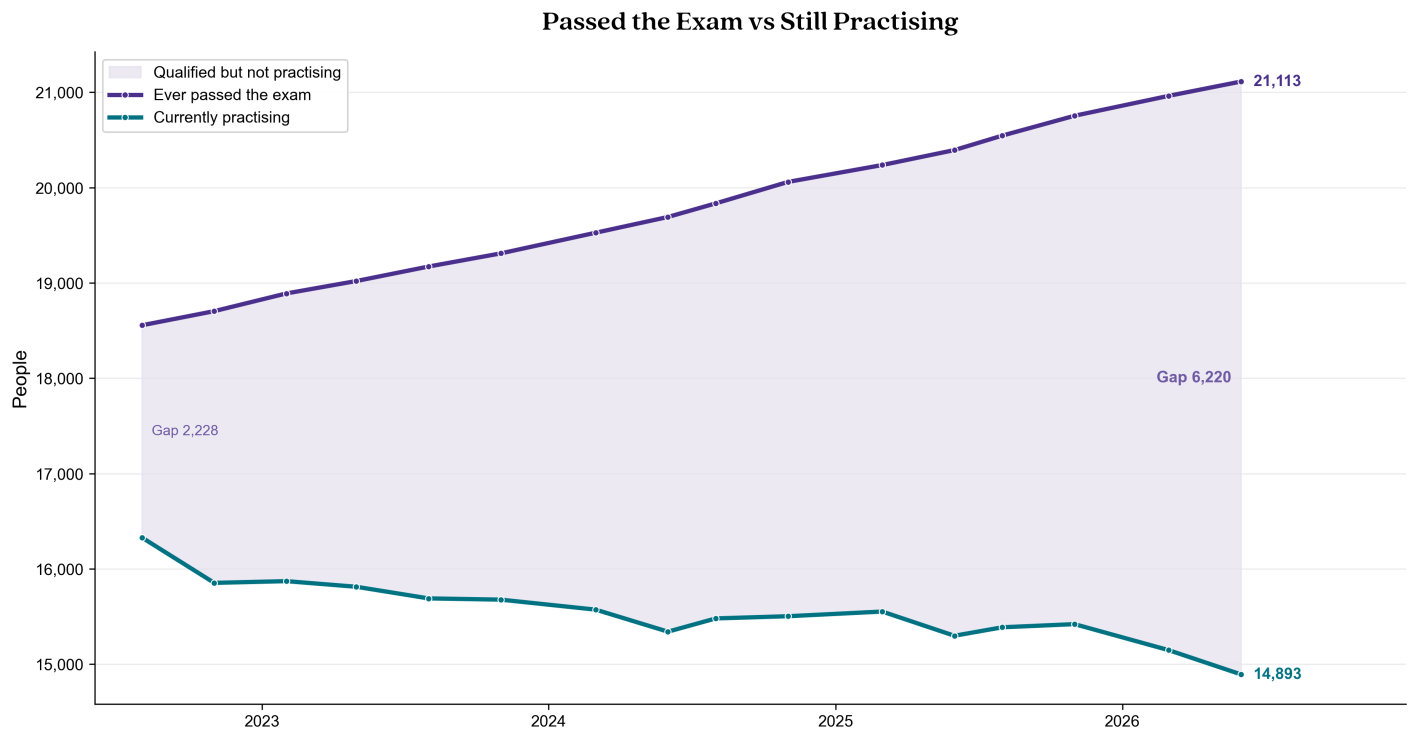
People who have ever passed the exam against those currently practising. The Australian Financial Adviser Market 2026, Padua Solutions.
It would be neat to treat 6,220 qualified people as the answer. It is not. Even if a meaningful share of them returned, and some do, with returning advisers a consistent quarterly inflow and 214 recorded in the September 2025 quarter alone, the reservoir would lift capacity by at most a few thousand advisers. Set that against 3.6 million Australian entities with a genuine need for advice, 1.8 million of them aged 60 or over, and the arithmetic does not close. The median projection has the workforce easing to 14,796 by 2030.
Which is the finding this series has been circling for five weeks. The profession cannot solve its access problem through headcount alone.
The One Lever That Does Not Need Legislation
The advice reforms are stalled and the pipeline will take years to rebuild. Productivity is the lever available now, and it works on the workforce that already exists. Applied to advice documentation, the compliance records behind it, research and workflow, technology lifts the number of clients each adviser can serve without touching the quality of the advice.
The proposed move from a long client document to a leaner advice record points the same way. As the client-facing paperwork thins, the analysis, the compliance records and the quality assurance remain and increasingly sit on the licensee's file. That makes the infrastructure beneath advice more important, not less, and it is precisely where the smaller licenses now carrying the market are least equipped to cope alone. Padua's dual-layer QA, Australian-trained paraplanners and audit-ready documentation are built to carry exactly that load.
End of the series
Read the full report, The Australian Financial Adviser Market 2026, free at wealthdata.com.au
Explore the data behind the report at wealthdata.com.au, including the free Adviser Movement Dashboards.
If you have any questions about the content of the report contact Lavon.Koopelian@paduasolutions.com

First Month Now Only $39.00 Selecting 'YEARLY' cost is only $950