

Superannuation Data By Fund Type To September 2025
APRA recently published its latest superannuation data by fund type, covering the period up to September, 2025. We combined this with financial adviser information, population stats from ABS, and SMSF data from ATO.
The data highlights that Industry Funds continue to dominate. However, Retail Funds have stabilised while SMSFs continue to be the major beneficiaries of transfers, now mostly out of Industry Funds.
Net contributions dipped for all fund types this quarter, which is typical due to the previous quarter being June. However, over a rolling 12 months and when compared to 12 months to Sep 2024, Retail Funds have increased their net contributions while Industry Funds have dropped.
Investment returns remain strong across all fund types and Retail Funds have closed the gap over recent times.
Admin and operating costs remain lower at Industry Funds as a percentage of assets. However, Retail Funds have stabilised and generally more competitive that what they were several years ago.
Notes: Re Asset Allocations - APRA is yet to release asset allocations for this data. ATO detailed SMSF data yet to be released for this quarter, we have used an estimate for this quarter.
Note: Full Set of Dashboards Available To Members - Join Here First month is only $39.00.
Key Highlights
Growth This Quarter and last 12 months (D2 - Select Chart Table $ and % Growth) - Net assets (for APRA Funds with $50 Mil or more in assets) increased by $113 Bil, from $3,129 Bil to $3,242 Bil. Over 12 months, net APRA assets are up by $323 Bil, moving from $2,919 Bil to $3,242 Bil.
Investment returns (D3 - select charts and dates) - The ‘Quarterly Totals Table’ shows that over the last quarter, Retail and Industry Funds both generated returns of 3.7% each. Over a rolling 12 month period (adding the 4 quarterly returns), Industry Funds are at 10% and Retail Funds at 9.4%.
Over five years, Industry Funds top the returns at 8.5% p.a. followed by Public Funds at 8.1% and Retail at 8.0%. For context, in September 2021, Industry Funds were at 8.6%, Public Funds at 7.9% and Retail Funds at 7.0%
Net Transfers To SMSFs (D7) - Net transfers to SMSFs from Industry Funds continue to grow. For the quarter the net transfers to SMSFs for Industry Funds is at (-$2,206 Mil, or -$2.2 Bil), easily the biggest quarter loss to SMSF Funds. For the year it is (-$6,538 Mil or $6.54 Bil). For context, back in Sept 2023, the yearly amount was (-$1.24 Bil)
Retail Funds are not immune to losing out to SMSF funds. However, prior to 2021, Retail Funds made up the largest share of losses and now, over he past 12 months the net loss is (-$1.98 Bil) or less than a third of what Industry Funds lost.
Net Contributions Dashboard (D5) Chart Shown Below - Over the quarter, all fund types had a reduced net flow compared to June which is normal. Over a rolling 12 months, Industry Funds still dominate at $62.06 Bil which below $72.51 Bil for the year to Sep 2024. Retail Funds are net at $22.10 Bil, almost double what they recorded for 12 months to Sep 2024 which was at $10.03 Bil.
Adviser Opportunity ( Dashboard 1) - As the number of advisers has steadied, the opportunity in terms of super fund assets per adviser has also steadied. There total assets for APRA and SMSF funds, when divided by the number of advisers as of Sep 2025 is $270 Mil per adviser, down slightly from $273 Mil for June 2025. The main reason for the drop being a strong improvement in the number of advisers since July 1. However, this will probably be short lived due an expected drop in adviser numbers as we enter 2026.
Investment Allocation - (Updated to June 2025) - Industry Funds have progressively allocated more to equities. For example, in 2023 Q2 they had 51.9% in equities and now at 57.7% for Q2 2025.
Members have access to 10 dashboards of data highlighting key move net of the main data points associated with Superannuation Funds. We have also updated our SMSF dashboards which provide significant detail to the SMSF sector.
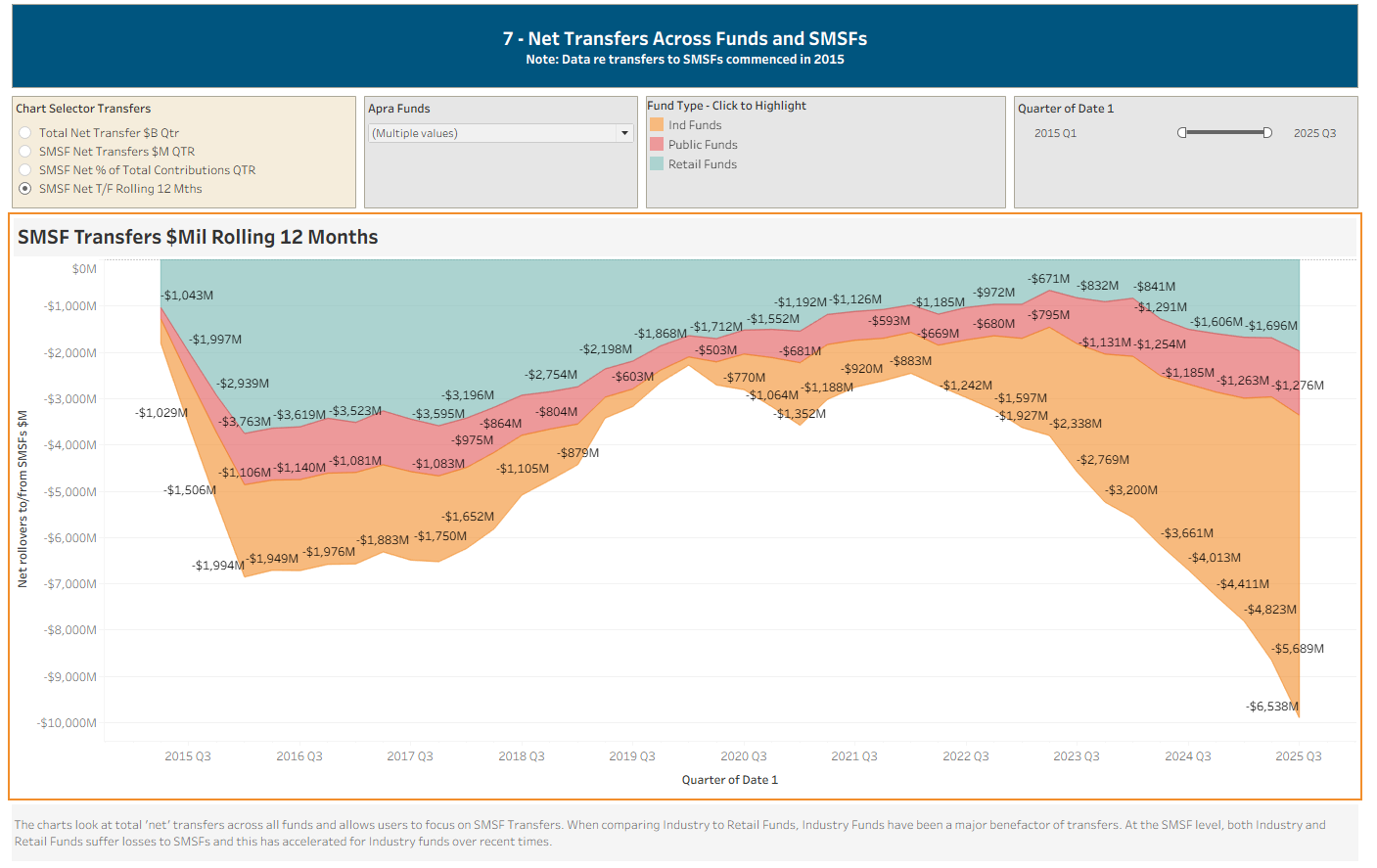
Net Transfers to SMSFs from Industry, Public and Retail Funds - Rolling 12 months.
You may also wish to see our detailed analysis of SMSF Funds, which also includes an overlay of Advisers