

Stability Is Not Recovery - Story 1 of 6
Net losses fell from 4,433 in 2019 to 151 in 2024, then widened again to 415 in 2025. The decline has not simply tapered away.
The first of six stories drawn from The Australian Financial Adviser Market 2026. Each one takes a single force reshaping the profession and shows the data behind it. We start with the number everyone quotes, the headline adviser count, and why a market that has stopped falling is not the same as a market that is getting better.
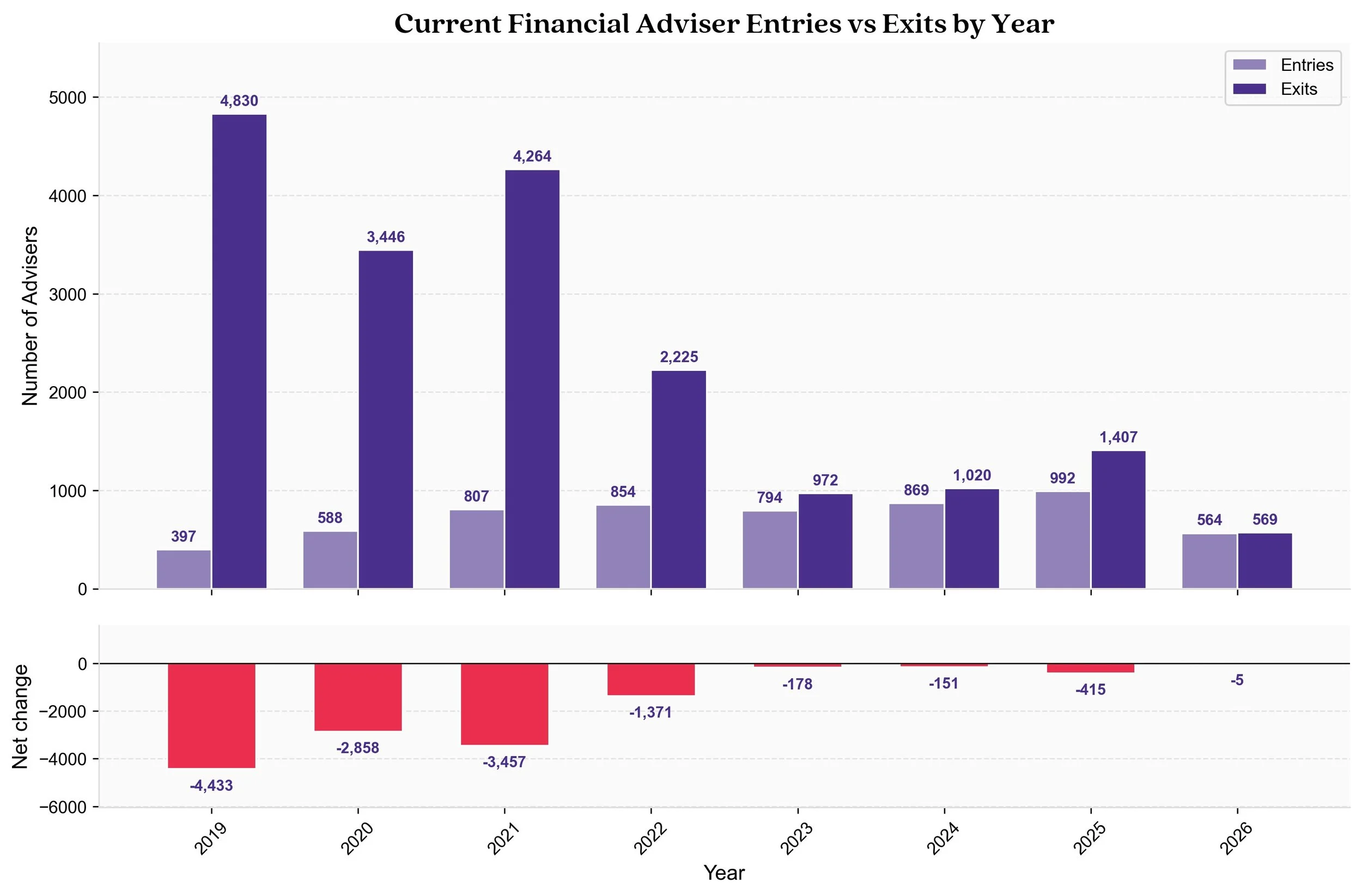
Adviser entries, exits and net change by year. The Australian Financial Adviser Market 2026, Padua Solutions.
The market has steadied because fewer advisers are leaving, not because more are arriving. Exits fell from 4,830 in 2019 to 1,020 in 2024, a drop of 3,810. Entries over the same period rose by just 472, from 397 to 869. Close to nine tenths of the turnaround is the exodus running out of people to take. That is why 2025 matters. Exits ticked back up to 1,407 and the net loss widened to 415, most of it backdated departures ahead of the education deadline rather than organic attrition. The bleeding slowed. The rebuilding has barely started.
The Australian Financial Adviser Market 2026 is Padua's data-driven read on the state of the profession. Drawing on the ASIC Financial Adviser Register and adviser exam data, it maps six forces behind a market that has stopped shrinking but is far from recovered: 15,012 advisers, ageing fast, against 3.6 million Australians who need advice. The conclusion is a shift in the question itself, from how to grow the workforce to how to get more from the one we have.
The Workforce That Stabilised Is the Most Senior We Have Had
Mean adviser experience is now 16.8 years, with a median of 17. That is not a workforce with a broad spread of junior to senior practitioners. It is a workforce carried almost entirely by its most experienced cohort.
39.9% of advisers have 20 or more years of experience. Just 13% have fewer than five. In 2018 those same figures were 19.6% and 30.0%, meaning there were more advisers in their first five years than there were 20-year veterans. Today the veterans outnumber them three to one.
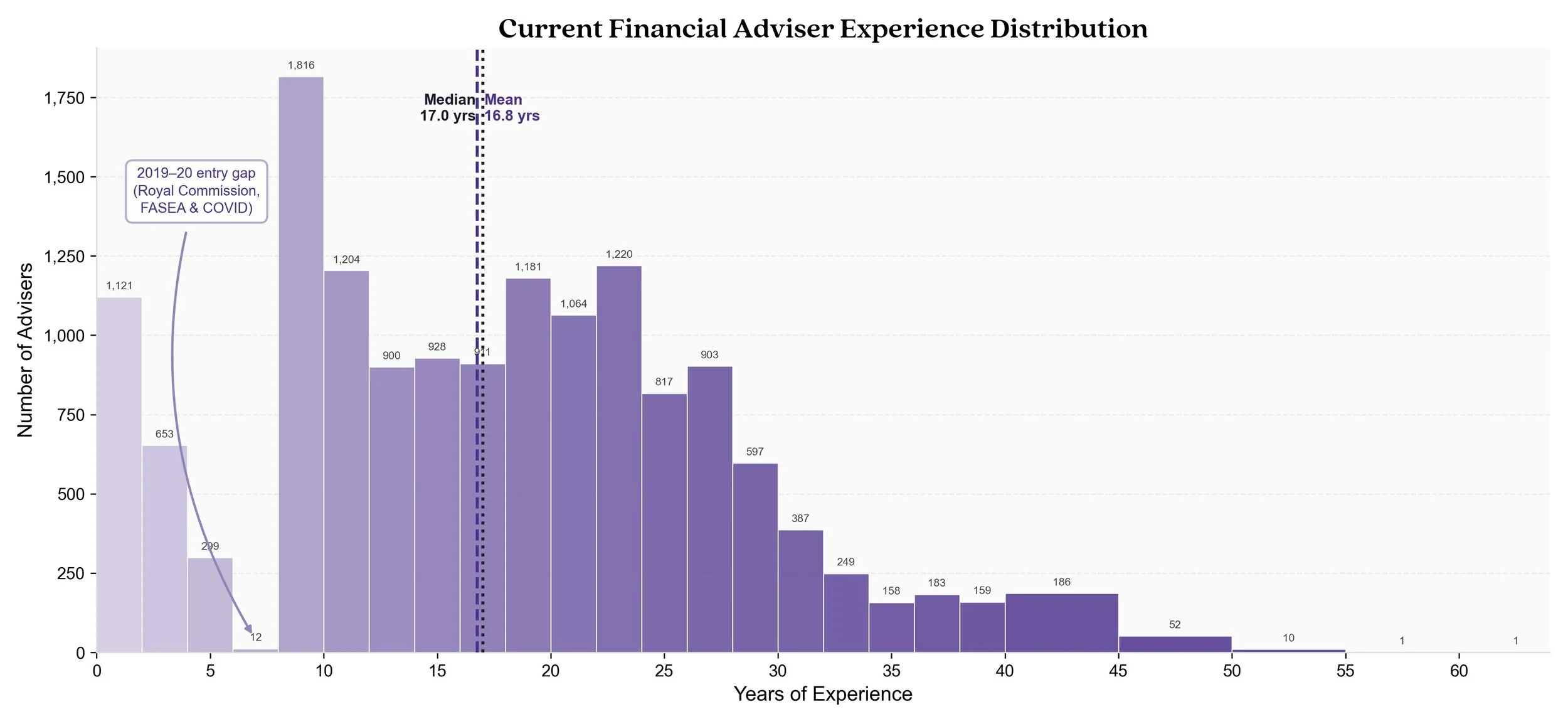
Advisers by years of experience. The Australian Financial Adviser Market 2026, Padua Solutions.
The band that is not there. The 6 to 8 year mark holds 12 advisers in total. That is the imprint of 2019 and 2020, when the Royal Commission, FASEA and COVID landed together and new entrants all but stopped. Those advisers would be hitting their stride about now.
The only cohort that grew. In absolute terms the 20-plus year band rose from 4,795 advisers in 2018 to 5,987 in 2026. It is the only band to add headcount while the total market fell from around 24,500 to 15,012. The 0 to 4 year cohort ran the other way, from roughly 8,400 at its 2019 peak down to 667 by 2023.
A real but fragile recovery. The 0 to 5 year cohort has climbed back from 4.3% of the market in 2023 to 13.1% in 2026, so the pipeline is refilling. Set against 30.0% in 2018, though, it is rebuilding from a historically depleted base, and at the current pace it does not offset the ageing above it.
There is a commercial logic to all that seniority. The most experienced advisers arguably had the most to lose by walking away. Many are running their own practices by now, with strong revenues and healthy business valuations, which left them better placed than anyone to ride the storm out rather than exit into it. When that cohort does step back, and a large part of it is within a decade of doing so, the shortfall will be structural rather than cyclical.
A Flat Line Can Be Read Two Ways
Our forecast has the market drifting to 14,796 by 2030. The comfortable reading is that the profession has found its floor. The accurate reading is that the headline count has momentum while everything underneath it is moving. A stable total can hide a workforce that is changing composition every year, and that is exactly what is happening here.
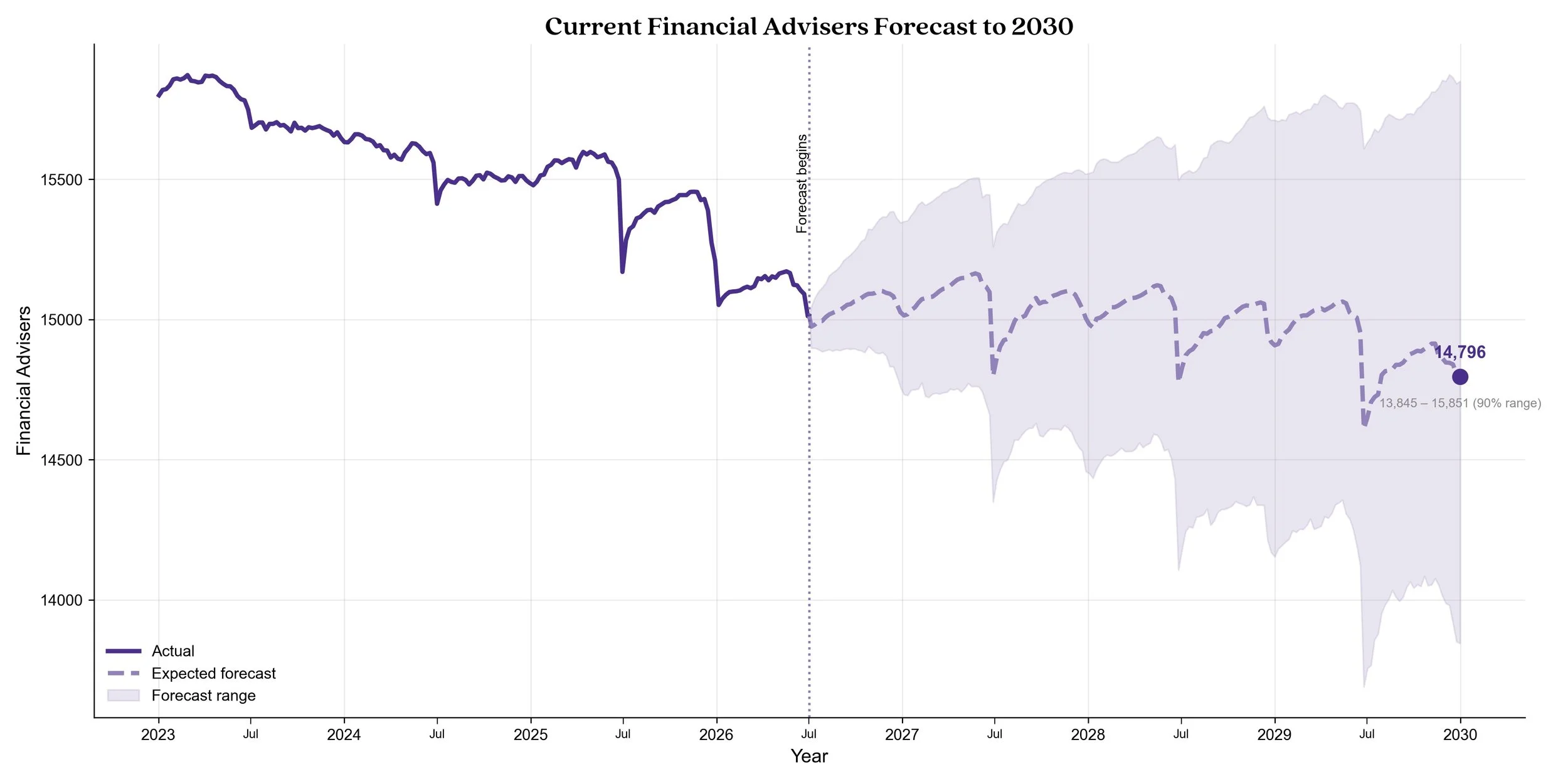
Adviser forecast to 2030, median with 90% prediction interval. Padua WealthData Forecast, July 2026. Range for 2030: 13,845 to 15,851 advisers.
Why It Matters
A flat forecast is not a neutral outcome when the workforce behind it is ageing and the replacement cohort is less than half the size it was. Holding 15,012 advisers steady through to 2030 still leaves the profession serving a demand base measured in millions with roughly the same headcount it has today. That is the case for treating productivity as infrastructure rather than an afterthought.
Next in the series. Story 2 looks at the training engine not enough replaced, and what happened to the pipeline when the banks walked away.
Read the full report, The Australian Financial Adviser Market 2026
Explore the data behind the report at wealthdata.com.au, including the free Adviser Movement Dashboards.
If you have any questions about the content of the report contact Lavon.Koopelian@paduasolutions.com

First Month Now Only $39.00 Selecting 'YEARLY' cost is only $950